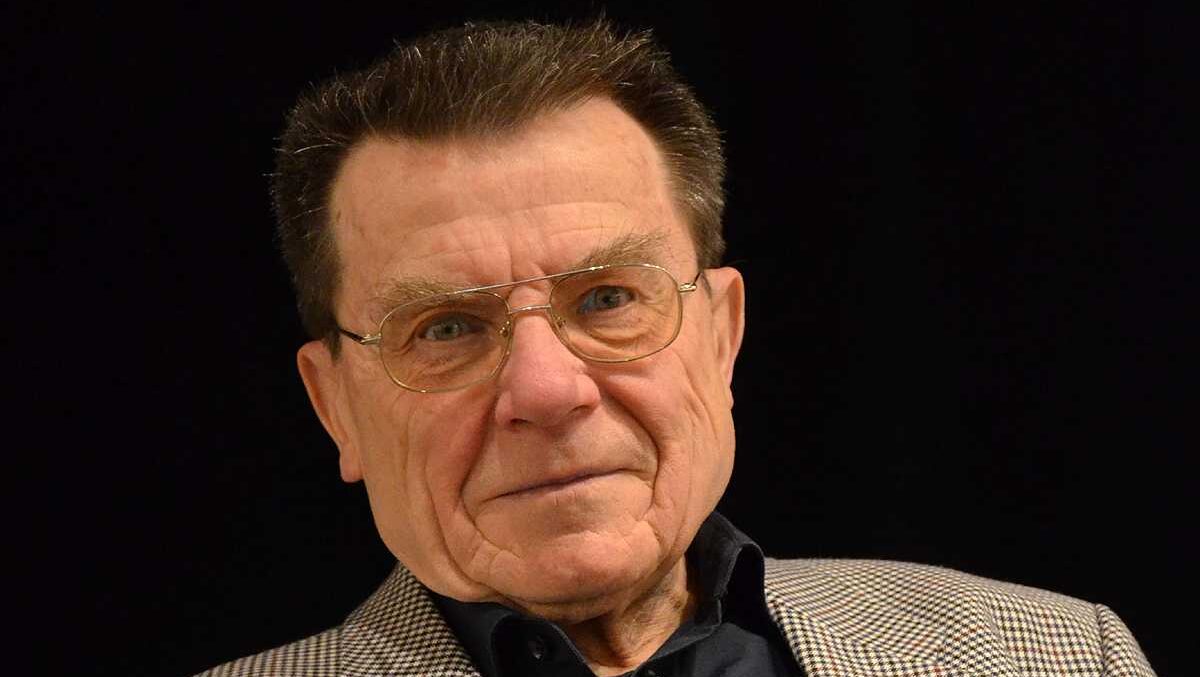
With a broken heart, we remember Lajos Rovátkay, our dear musician friend and mentor, a member of the Haydneum Scientific Committee, who returned to his Creator on 2 January 2026, in the ninety third year of his life. This remarkably versatile musician, researcher, conductor, organist and harpsichordist, and distinguished musicologist was a professor at the Hochschule in Hanover.
Lajos Rovátkay was born in Óbuda Hungary. After completing his studies at the Archiepiscopal Grammar School, he continued at the Conservatoire and later at the Liszt Academy of Music, studying under such outstanding teachers as János Hammerschlag, György Sebők, Lajos Bárdos and Rezső Sugár. He maintained close relationships with key figures of the musical life of the period, including Aladár Tóth, Bence Szabolcsi and György Ligeti.
In 1955 he founded the early music ensemble Collegium Musicum, with which he performed works by Schütz, Tunder and Buxtehude.
In 1956 he left Hungary with a single rucksack. It contained nothing but a notebook in which he had collected and organised articulations drawn from the instrumental parts of Bach’s cantatas.
He studied at the Frankfurt Hochschule with the organist Helmut Walcha. While János Hammerschlag had influenced him with a rhetorical and agogically rich manner of playing, Walcha left a profound impression through his clear and transparent style.
He was personally acquainted with Paul Hindemith and frequently took part in his concerts as a continuo player.
A few years later he moved to Hanover, where he began teaching organ and piano at the Hochschule, later adding the harpsichord, and subsequently assumed the leadership of the already established early music studio.
He was passionately interested in the early Baroque. He researched the oeuvre of Alessandro Grandi and his contemporaries, copied their works from manuscripts, and incorporated them into his teaching and performances. Later he prepared scholarly editions and made recordings with the ensemble Musica Antiqua Köln. His lifelong enthusiasm for Venetian Baroque music began with Grandi and led him to the art of Agostino Steffani, whose connections to Hanover were particularly strong. On the three hundredth anniversary of the founding of the Hanover Opera, he presented Steffani’s opera Enrico Leone with his own ensemble, the Capella Agostino Steffani, and conducted it over two consecutive seasons.
The “Venetian red thread” then guided him towards Antonio Caldara, who transmitted Venetian traditions into the Viennese Baroque. From there, through his boundless enthusiasm for Gregor Joseph Werner, he arrived at the Esterházy Baroque. He recorded five CDs of Werner’s music with two ensembles that were particularly close to his heart, La Festa Musicale and the Voktett Hannover. He greatly anticipated the release of the fifth disc and was just able to live to see it appear.
Numerous other music editions and CD recordings are also associated with his name.
The immeasurable depth of Lajos Rovátkay’s knowledge and his passion for music remain exemplary for us. His exceptional insights into musical relationships reveal how profoundly thoughtful a practising musician he was.
He was especially fascinated by Renaissance vocal polyphony and by early Baroque bass patterns such as the romanesca and the ruggiero. Restlessly, he investigated the role of the ritornello form in Bach, examining how Bach combined and embedded it within counterpoint in a wholly unique and personal manner. He devoted enormous attention to what the augmented sixth expressed and how it functioned as music progresses in time, compiling an entire theoretical compendium of its various manifestations. He also possessed a vast knowledge of the origins of Baroque thematic topoi, most notably fugue subjects. One could recount the subjects of his enthusiasm endlessly, yet for him the most essential presence always remained the cosmic energy of Johann Sebastian Bach.
Ágnes Pintér, 5 January 2026
Haydneum – Hungarian Center for Early Music produced a portrait film in 2024 about the internationally renowned organist, harpsichordist, conductor, and musicologist, which premiered on February 17, 2025, at the Hatvany-Lónyay Villa in Budapest.
Filmed in beautiful locations, this personal film not only reveals the artist’s often turbulent and adventurous life, but also has deep professional content, sensitively interweaving history and art with personal stories.